TKS Session 16: AI x Biology
This is our first “real” session back from the break, where we got to dive into a lot of technical work, critical thinking, and active participation revolving around the intersection of AI x biology. This is the first of a “series” of sessions this month, all focused on AI x [insert industry]. We will be spending the entire month learning about the different ways that AI can be used in different fields of work and contexts.
Before diving into our session, we started with an anti-MotW, which was imposter syndrome. Imposter syndrome is when you feel like you don’t belong somewhere or you aren’t deserving of something, even if you already earned it. For example, a lot of people may feel imposter syndrome when going to university, even though they got accepted into the program. Or, people may feel imposter syndrome when on the first day of a new job, even though they got hired for it in the first place. Imposter syndrome makes you believe that everyone else is “judging” you and that you shouldn’t be where you are or shouldn’t have gotten the opportunity you did. Imposter syndrome can also cause you to downplay your skills or undermine yourself because you believe that you didn’t earn your opportunity, which may cause you to take fewer chances or speak up less in fear of being “discovered”. It’s important to go over anti-MotWs so that we can be aware of the ways we hinder our growth and actively try to overcome them.
For imposter syndrome, the ways to overcome that are simply by trying to build your own self-confidence and acknowledge that you earned your spot and that you are worthy to be where you’re at, especially if you’re striving to be better. It doesn’t matter if you’re the “dumbest” in the room, but you made the cut to be where you’re at, and no one is stopping you from learning and getting better.
After going over the MotW, we moved into the AI x Biology portion. Part of that portion was going over a TKSkill, which is TAM SAM SOM. TAM SAM SOM is a tool we use to analyze a product’s potential market. The acronyms stand for:
TAM: Total Addressable Market - How big is your largest market?
SAM: Servicable Available Market - What part of that market fits your targets?
SOM: Servicable Obtainable Market - What portion of the market are you able to reach?
Being able to conduct TAM SAM SOM allows you to properly evaluate the market that is realistic for you to reach with your product and the one that directly applies to what you are building.
Then, we went over the three main ways we can implement AI into the fields of biology and medicine to prep us with a little background before the activity. The three overarching buckets for use are:
Drug discovery
Data analysis/organization
Biology modelling
It was a pretty basic overview because we wanted to jump right into the activity, which was analyzing a case study for a company called Ginkgo Bioworks, who were looking to determine what new market to enter and what product to develop in that market. Here is the Ginkgo case study:
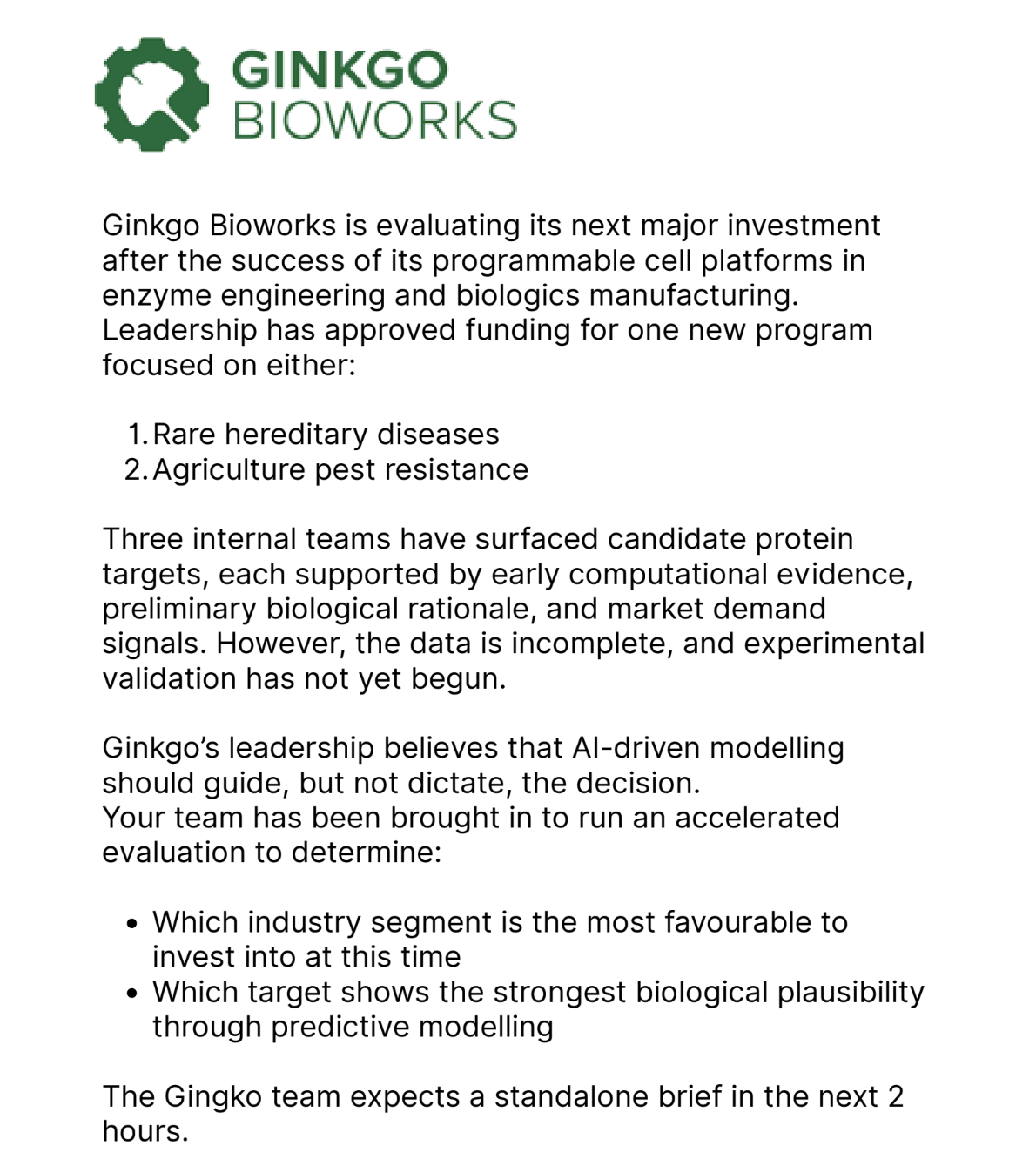
Ginkgo Bioworks case study information
From the initial info in the case, we see that Ginkgo is choosing between entering 2 different markets with their protein targets, either agricultural pest resistance or rare hereditary diseases. Then, once we chose what market would be the best bet for Ginkgo, we would then have to decide which protein target has the strongest biological plausibility and would be the best option to move forward with.
After reading this overview, we had to tackle the first part of this question, which is deciding the target market. We got to ask our director questions for specific pieces of information, like market trends, R&D costs, potential profit, timelines, etc.
After getting the required information, our team decided that the agriculture pest control market would be the best one for Ginkgo to proceed with. We then created an entire recommendation for why we chose the agriculture pest control market using the data given to us. Part of that recommendation also required us to conduct TAM SAM SOM for the company, the chosen field, and its product. You can read over the recommendation below for more information and to get a glimpse of the data we used.
The TAM SAM SOM on slide 2 and the entirety of slide 3 are all included in part 2 of the case study, which required us to evaluate the protein targets and decide which one would be the strongest target to move forward with in testing.
We were given information about all of the protein targets (3 for the agriculture pest control market and 3 for the rare hereditary diseases market) and would choose out of the 3 that were relevant to our market choice. Here is the info we got for the target proteins in the agriculture pest control market (our market choice):
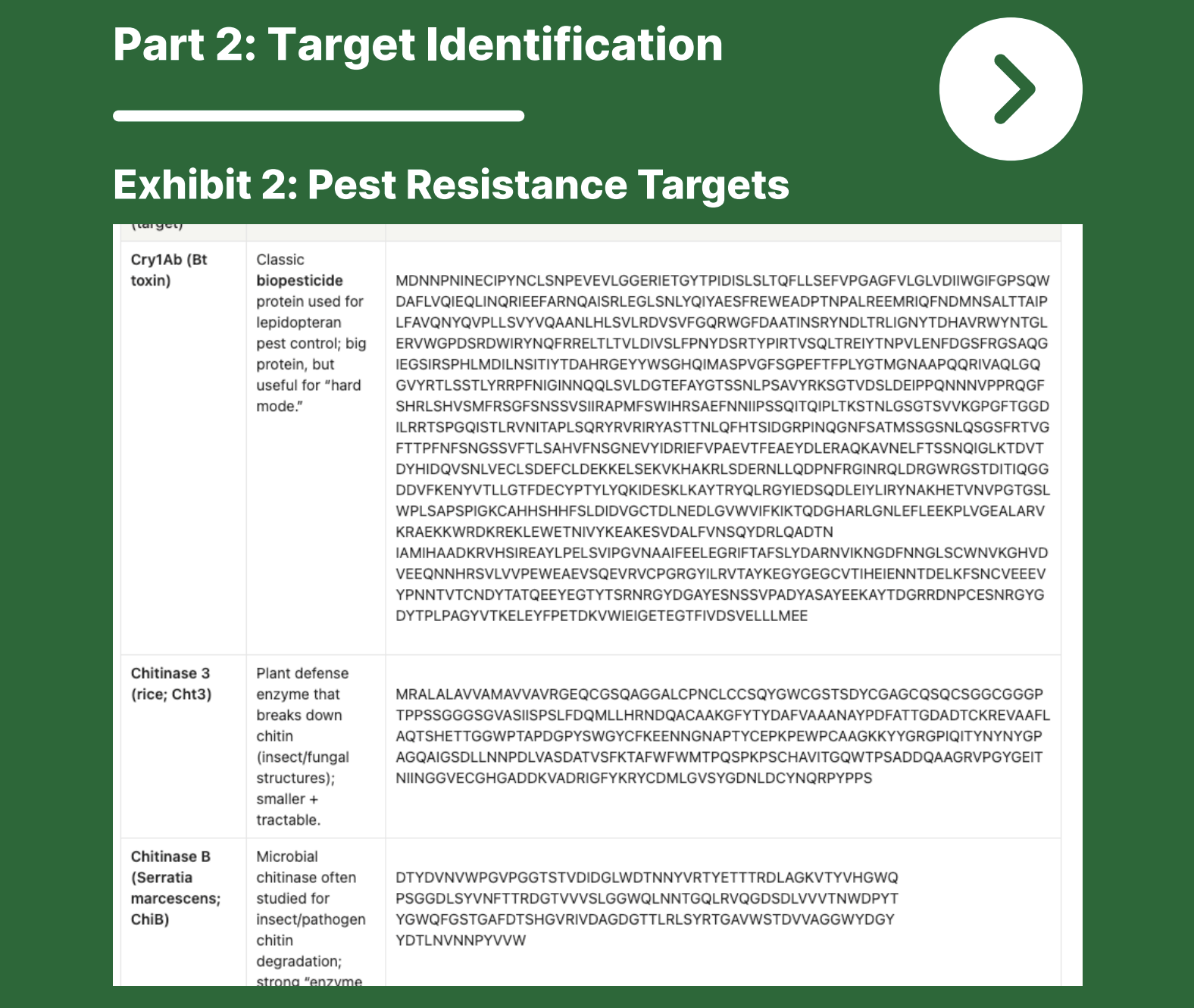
The protein target data for the agriculture pest control market
In the case study, in order for us to determine the best protein target choice, we had to determine its biological plausibility. To do this, we used a tool called AlphaFold, which takes a protein sequence and recreates what the protein looks like (diagrams in slide 3 were generated using AlphaFold) and gives the protein 2 different scores:
ipTM score (Interface Predicted Template Modelling): Accuracy of the predicted relative positions of the different components within the complex (colour-coded based on how accurate it is)
pTM score (Predicted Template Modelling): The overall predicted fold for the complex in similarity to the true structure
When determining which protein target has the strongest biological plausibility, you can simply go off which target has the highest scores. After running the predictions, we found that the protein target Chitinase 3 had the strongest biological plausibility, so we chose that protein target for our final recommendation.
Since we had decided which protein target to develop in the agriculture pest control market, we were then able to complete our TAM SAM SOM. As you can see in the screenshot, the protein target Chitinase 3 breaks down insect/fungal structures, so our SOM is the market that focuses on microbial microfungicides (the type of pest control Chitinase 3 falls under).
To finish off our session, we had a little ethical discussion about the use of AI in drug discovery. The question was: You are dying due to an incurable condition. Do you decide to take a new drug that was completely discovered by AI that might be able to cure you, or do you take a drug that has already been tested and proven by humans to extend your lifespan?
When going over this question, a lot of us believed that it was too vague. We would need to know how long we have to live currently, how much longer we would live if we take the already proven drugs, etc. But, without all this information, I would probably not want to take a drug completely discovered by AI, mainly because there is no confirmed information about the side effects of taking this drug. Yes, it may be able to extend my life span or even cure me, but what state will I be in when I’m cured (maybe I will be paralyzed, for example)? That unknown is too big a risk for me, which is why right now I am against the idea.
And that was the end of this session. Overall, I really enjoyed this session compared to some of the other ones, and I’m definitely looking forward to all the case studies we will be working on this month because they will be more hands-on and interactive.
